
Our Science
Our Vaccinia Enhanced Template (VET™) platform enables the engineering of tumor-selective oncolytic vaccinia viruses with targeted delivery capabilities and diverse therapeutic payloads. Our lead candidate, VET3-TGI, combines direct tumor lysis with TGF-β inhibition and IL-12 expression, built to make “cold” tumors “hot” and “hot” tumors “hotter.”
The problem
Most patients relapse on, or never respond to, checkpoint inhibitors. TGF-β is a potent suppressor of immunity and a major factor in whether patients respond to checkpoint therapy, yet no TGF-β inhibitor has been approved for cancer, largely because of poor specificity and tumor infiltration. VET3-TGI delivers a novel TGF-β inhibitor directly into the tumor.
Cold tumors
Too few antigens and danger signals to trigger immunity
Tumor lysis + viral replication
Releases antigens and PAMPs, designed to turn cold tumors hot
Immunosuppressive microenvironment
TGF-β, regulatory T cells and MDSCs block T-cell entry and function
TGF-β inhibitor payload
Designed to remodel the tumor microenvironment and reopen tumors to immune cells
T-cell exhaustion
Chronic exposure leaves T cells unable to fight
IL-12 cytokine expression
Drives potent, synergistic T-cell activation
The VET™ platform
A Western Reserve vaccinia virus engineered with VET™ backbone modifications and two therapeutic transgenes, IL-12 and a TGF-β inhibitor, expressed locally in the tumor.
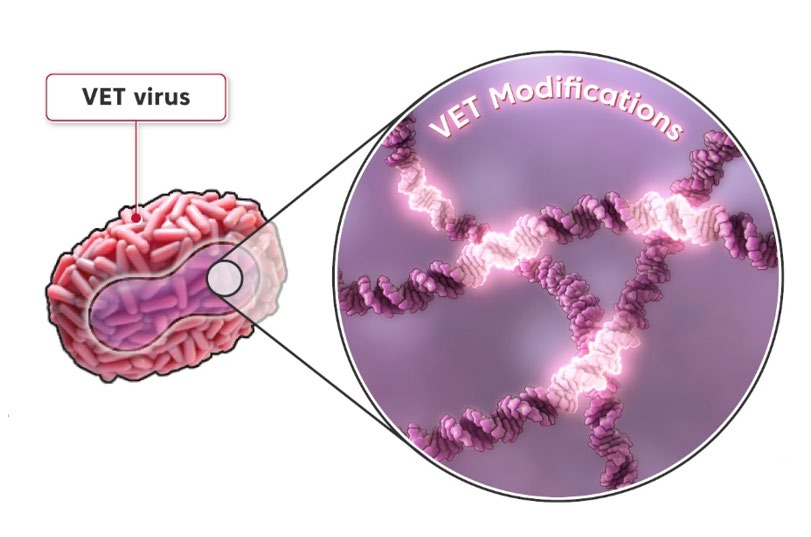
Full deletion of the viral thymidine kinase and the A52R NF-κB inhibitor is designed to restrict replication to tumor cells, destroying them and releasing tumor antigens with increased selectivity.
A chemokine receptor engineered into the backbone for targeted systemic delivery to CXCL9-, CXCL10- and CXCL11-expressing tumors.
A potent, pro-inflammatory type 1 cytokine that induces and enhances cell-mediated antitumor immunity at the tumor site.
A novel mini-monomer binds the TGF-β type II receptor and blocks TGF-β signaling, a pathway linked to immune exclusion and reduced antitumor T-cell function.
Discovery research
KaliVir’s integrated discovery and research capabilities enable the design, engineering, and preclinical evaluation of novel oncolytic vaccinia candidates. Leveraging our proprietary VET™ platform and expertise in viral engineering, tumor immunology, and therapeutic payload development, we continuously explore new approaches to enhance tumor targeting, immune activation, and antitumor activity.
Our discovery capabilities support both the advancement of our proprietary pipeline and research collaborations with strategic partners.
Integrating novel therapeutic payloads, such as cytokines and bispecific antibodies, into our proprietary vaccinia delivery vehicles.
Advancing VET™ modifications designed for intravenous delivery, to reach metastatic disease beyond injectable tumors.
A next-generation oncolytic vaccinia candidate built on our VET™ platform, combining tumor-selective replication with a novel, undisclosed therapeutic payload. VET6-PDI is in preclinical development for advanced or metastatic solid tumors.
Intellectual property
An extensive global patent estate, with protection extending through 2037 to at least 2043 in major markets.
Multiple owned and exclusively licensed patent families across the U.S., Canada, Europe and Asia-Pacific, including China and Japan, cover composition of matter, manufacturing and process, therapeutic applications of VET™-derived viruses, each lead program and therapeutic transgene, and delivery.